The state of AI adoption, in real numbers
From published 2026 research. Reconciled when studies disagree. Every number is sourced.
TechStack Strategy
Want to learn how to bring practical AI into your small business?
TechStack Strategy helps small businesses identify the highest value opportunities for AI, prioritize what to implement first, and build practical systems that improve productivity, streamline operations, and drive growth.
Build Your AI Strategy →Guides on AI costs, tools, marketing, and workflows. Real adoption data from Census, Fed, Intuit, and Goldman Sachs.
7 categories, 25+ tools ranked by real value. What each costs, who it's for, and what it can't do.
Compare tools →COST GUIDEReal pricing by category and business size. From $20/mo tools to $20K custom builds. When it pays for itself.
See the numbers →MARKETINGWhat to automate, what to keep human. Copy-paste prompts for email, social, ads, reviews, and SEO.
Start marketing with AI →IMPLEMENTATIONThe Implementation Atlas: what to automate first, ranked and scored, with a 30-day path.
Open the Atlas →PLAYBOOKThe 30-day adoption playbook for owners who don't know where to begin. Step by step.
Start here →USE CASESAI by business function, each with a 15-minute try-it. See what works before you commit.
Browse use cases →Specific AI use cases, tools, and pricing for your trade.
Call answering, scheduling, invoicing, and local SEO for plumbing businesses.
Read the guide →DENTALAppointment reminders, patient reactivation, reviews, and insurance automation.
Read the guide →LEGALDocument drafting, intake automation, legal research, and conflict checking.
Read the guide →REAL ESTATELead qualification, property descriptions, follow-up, and market analysis.
Read the guide →CONSTRUCTIONEstimating, scheduling, invoicing, reviews, and local SEO for contractors.
Read the guide →HYPE VS REALITYWhat is overhyped, what actually works, and how to tell the difference.
Read the guide →From published 2026 research. Reconciled when studies disagree. Every number is sourced.
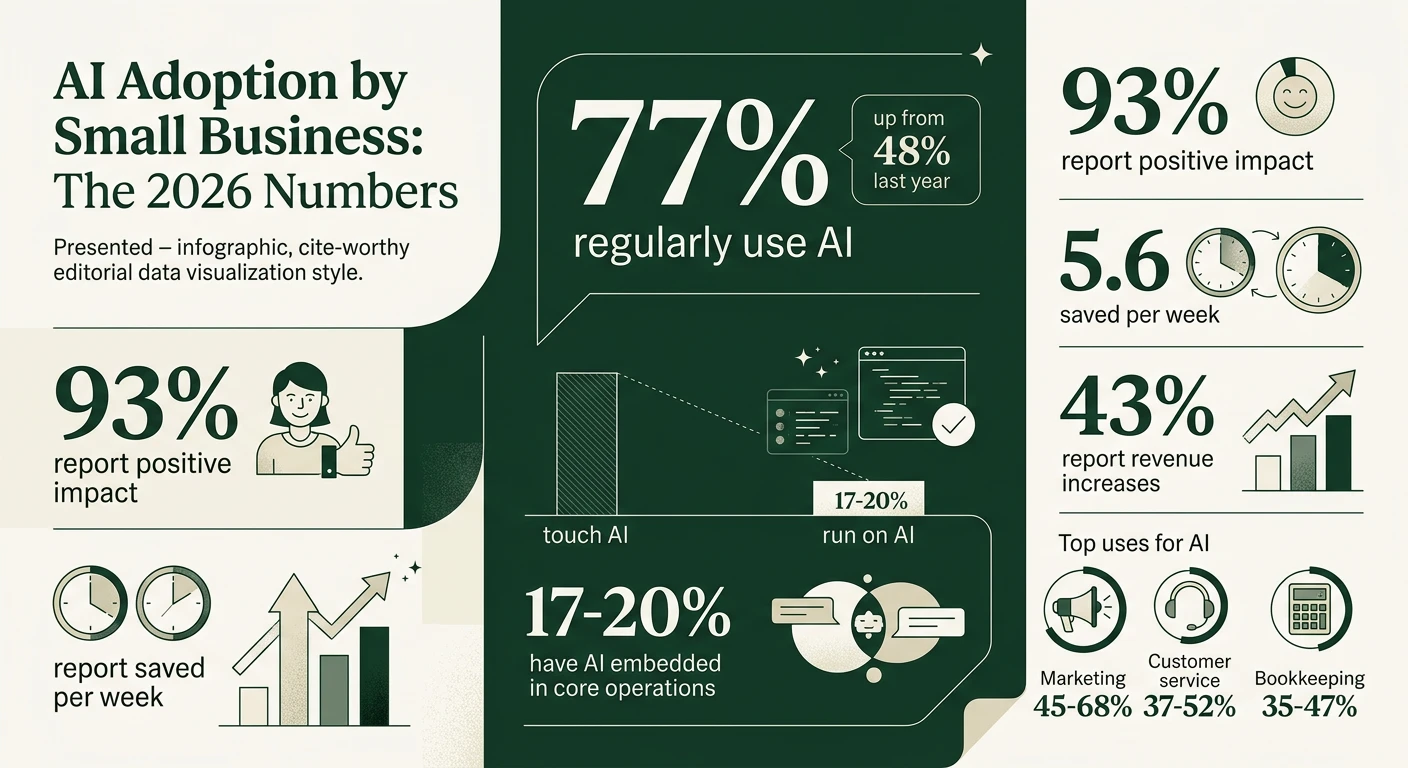
68-77% of US small businesses regularly use AI tools, but far fewer have it embedded in core operations. The gap between "we use ChatGPT sometimes" and "AI runs part of our business" is the defining story of 2026.
77% regular use vs. 14% fully embeddedEvery study measures something different. Broad definitions produce 68-89%; strict definitions produce 17-46%. They're all "right" about different things.
Full reconciliation at /statistics/adoption/Marketing and content creation lead everywhere, followed by customer service and bookkeeping. Core operations come later, if ever.
Marketing 45-68% · CS 37-52% · Bookkeeping 35-47%Over half of surveyed owners cite "not knowing where to start" as their top barrier. That's what this site is for.
51%+ say "don't know where to start"Find out where you stand and what to do next.
Five stages from experimenting to embedded. Find your stage and what to do next.
Take the assessment →DATA DASHBOARDFilter adoption data by industry and company size. See where your sector stands.
Explore the data →RESEARCHEvery verified statistic on AI and small business, sourced and dated. Free to cite.
Browse the numbers →Direct answers, sourced. No jargon.
Roughly 68-77% regularly use AI tools (Intuit: 77%; U.S. Chamber: 68%). Under stricter, operations-embedded definitions: 46% (Federal Reserve) down to 17-20% (Census Bureau BTOS).
A typical small business can start with AI for $20 to $100 per month using off-the-shelf tools. More advanced setups with workflow automation run $100 to $500 per month. Custom AI development ranges from $2,000 to $20,000 one-time. See our full cost guide for details.
It depends on your needs, but the most useful categories are AI phone answering, chatbots, writing assistants, marketing automation, bookkeeping, scheduling, and workflow integration. See our ranked tool guide for specific recommendations and pricing.
Self-reported data says yes for many: 43% of AI-using businesses report revenue increases (Intuit, 2026); the U.S. Chamber reports 91% of AI users saw revenue gains. Treat self-reported figures with appropriate skepticism; see our methodology page.
"Not knowing where to start" is cited by over half of surveyed owners (Oken AI, 2026). Data privacy concerns, fear of errors, and limited knowledge of capabilities follow. That's exactly what this site addresses.
Every number is linked to its original source: U.S. Census Bureau, Federal Reserve, Intuit, Goldman Sachs, U.S. Chamber of Commerce, and others. Reconciled when studies disagree. See methodology.
The data and findings on this site are published under a Creative Commons Attribution license. Quote them, chart them, and republish freely, with credit.
State of AI for Small Business. stateofaiforsmallbusiness.com. Licensed CC BY 4.0.
One email a month. New findings, a tool review, and one actionable AI workflow you can implement in under an hour. No fluff.
Free. Unsubscribe anytime. We never share your email.