The Honest Breakdown
AI hype vs. reality: what actually works for small business in 2026
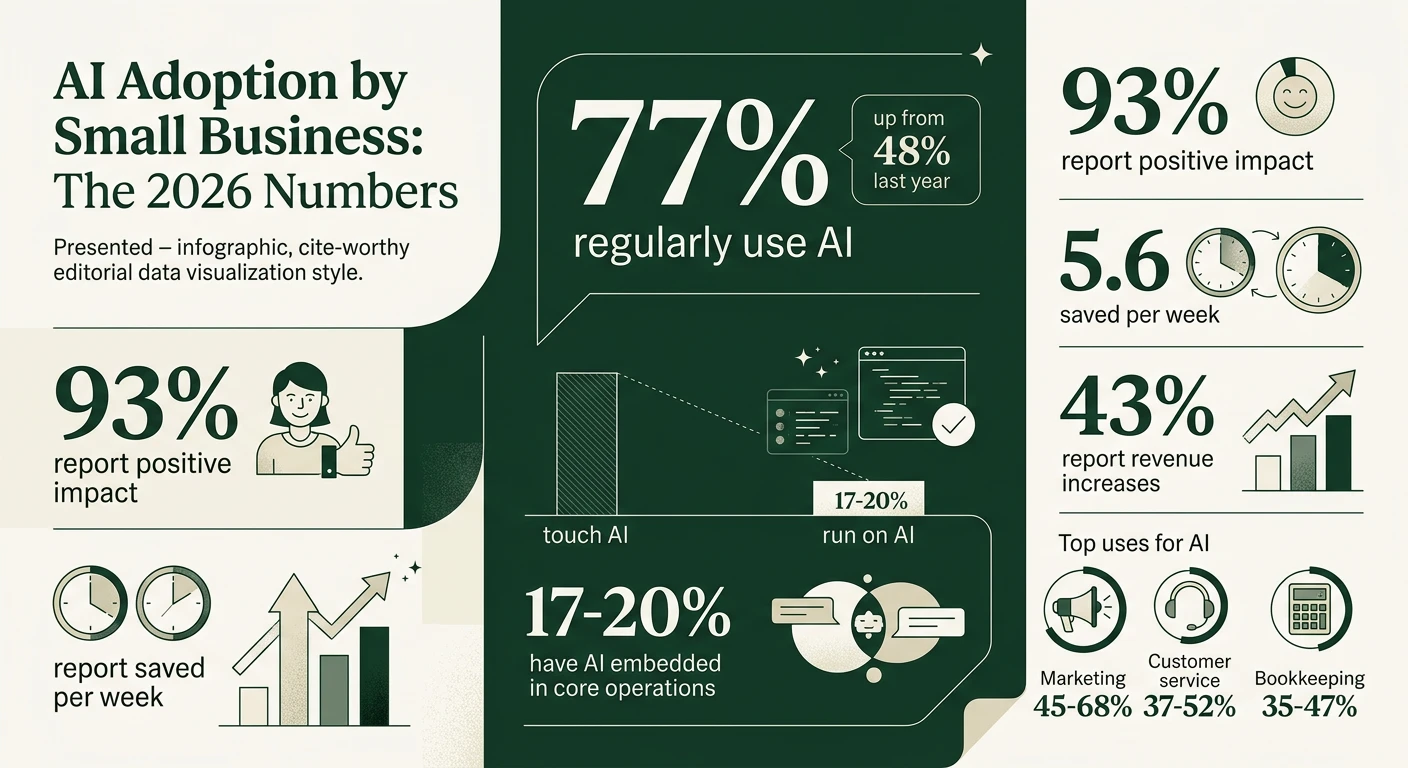
77% of small businesses use AI. 93% say it helps. But what does that actually mean? Here's the honest breakdown of what works, what's overhyped, and what's not ready yet — with real numbers, real costs, and no sales pitch.
Last updated: July 2026We're not an AI vendor. We don't sell AI tools. We don't have affiliate links. We track how small businesses are actually using AI — what's working, what's failing, what's a waste of money — and we report it straight. This page is the distillation of that work. No hype. No fear-mongering. Just the truth, with the numbers to back it up.
What deliversWhat actually works
These are the AI use cases that consistently deliver measurable ROI for small businesses. Not theory — these are the tools that real businesses are paying for, using daily, and seeing results from. Each one solves a specific problem, has a clear cost, and produces a number you can measure.
AI call answering
Why it works: The average service business misses 20–30% of incoming calls — while on a job, after hours, or during peak demand. Every missed call from someone with an urgent problem goes to your competitor. AI answers instantly, 24/7, books the appointment, and captures the lead.
Cost: $50–60/month · Tools: Goodcall, Rosie AI, Smith.ai
Speed-to-lead automation
Why it works: The business that responds first wins. When a lead fills out a form or calls, AI sends an instant personalized response — before your competitor even sees the notification. Speed-to-lead is the single biggest factor in conversion after the initial contact.
Cost: $30–100/month · Tools: HubSpot, Follow Up Boss, Zapier + AI
Client reactivation campaigns
Why it works: Most businesses have a list of past customers they've completely lost track of. AI drafts personalized reactivation messages at scale — SMS, email, voicemail drops — turning dormant contacts back into paying customers. This is the highest-ROI marketing activity most businesses aren't doing.
Cost: $0–50/month · Tools: ChatGPT/Claude + your CRM
AI writing for marketing content
Why it works: Writing is the task most small business owners hate and procrastinate on. AI drafts emails, social posts, ad copy, newsletters, and website copy in minutes. You still edit and personalize — but the blank-page problem is solved. This is the easiest AI win for any business.
Cost: $20/month · Tools: ChatGPT, Claude, Jasper
Appointment scheduling and reminders
Why it works: No-shows are a silent revenue killer. AI-powered scheduling sends automated reminders via SMS and email, allows customers to self-book 24/7, and follows up on reschedules. The reduction in no-shows alone often covers the monthly cost within the first week.
Cost: $20–80/month · Tools: Jobber, Housecall Pro, Calendly + AI
Review generation automation
Why it works: Google reviews are the #1 factor in local search rankings. Most businesses don't ask for reviews consistently because it's awkward and easy to forget. AI automates the ask — sending a review request via SMS within 30 minutes of job completion, following up once, and drafting responses to reviews for your approval.
Cost: $75–110/month · Tools: NiceJob, Podium, Birdeye
Bookkeeping and invoice automation
Why it works: Bookkeeping is repetitive, error-prone, and the task most owners delay. AI categorizes transactions, generates invoices from job data, sends payment reminders, and flags anomalies. It doesn't replace your accountant — it eliminates the data entry that eats your evenings.
Cost: $20–50/month · Tools: QuickBooks AI, Wave, Dext
Document drafting for legal and professional services
Why it works: Lawyers, accountants, and consultants spend hours drafting documents that follow predictable structures. AI generates first drafts of contracts, memos, engagement letters, and reports in minutes. The professional reviews, edits, and finalizes — but the drafting time collapses from hours to minutes.
Cost: $20–120/month · Tools: Claude Pro, Spellbook, Harvey AI
Be skepticalWhat's overrated
These are the things people claim AI can do, but that don't deliver well yet for most small businesses. Not that they'll never work — some will improve. But in 2026, paying for these is more likely to waste your money than save it.
AI chatbots for complex customer service
Chatbots frustrate more than they help for most small businesses. They can't handle edge cases, nuanced complaints, or multi-step problems. Customers hate being trapped in a bot loop when they have a real issue. For simple FAQ answering, they're fine. For anything that requires judgment or empathy, they damage your reputation more than they save you time.
Fully autonomous AI agents
"Set it and forget it" doesn't work. Every automated workflow needs human oversight and regular tuning. AI agents drift, make mistakes on edge cases, and break when APIs change. The vendors promising fully autonomous agents that run your business while you sleep are selling a future that isn't here yet. The best AI workflows have a human checking the output — always.
AI-generated SEO blog posts
Google is getting better at detecting and deprioritizing AI content. Also, nobody reads mediocre content. Pumping out 50 AI blog posts that say nothing new won't help your rankings — it'll hurt them. AI is great for drafting content when you have something real to say. It's terrible for generating content to fill space. Quality over quantity, every time.
Replacing relationship-based sales with AI outreach
People buy from people they trust — especially in B2B and service businesses. AI-generated cold emails and automated LinkedIn outreach have saturated inboxes to the point where prospects ignore them entirely. AI can help you research prospects and draft messages, but the actual relationship-building needs a human. If your sales process is built on trust, don't outsource the trust part.
AI for strategic decision-making
AI is great at summarizing data but terrible at judgment calls about your specific market, your specific customers, and your specific constraints. It doesn't know your cash flow situation, your team dynamics, or your local competitive landscape. Use AI to gather and organize information. Make the strategic decisions yourself — that's what you're good at.
"AI will replace your receptionist"
It won't — it supplements, it doesn't replace. The best setups use AI for after-hours and overflow calls, and humans for relationship calls. Your receptionist builds rapport, handles complex scheduling, reads the room when a customer is upset, and represents your brand. AI answers the phone at 11 PM when nobody's in the office. They're partners, not substitutes.
Watch this spaceWhat's not ready yet
These are emerging capabilities that sound impressive but aren't reliable enough for small business use in 2026. They'll get there — some within a year or two. But right now, betting your business on them is premature.
AI phone calls that sound human
Getting close, but still in the uncanny valley. Customers can tell something is off — the pauses are slightly wrong, the responses are a beat too perfect, the tone doesn't shift naturally. For routine call answering it's fine. For anything that requires building rapport or handling a frustrated customer, the slight artificiality erodes trust. Give it 1–2 years.
Fully automated social media
AI can draft posts, but it can't read the room or respond to cultural moments. Automated social media that posts the same generic content regardless of what's happening in the world feels tone-deaf. Worse, AI can't engage authentically in comments or handle a PR moment. Use AI to draft your social calendar — then have a human review, schedule, and engage.
AI video generation for marketing
Too expensive, too slow, and the quality isn't there yet for small business budgets. Enterprise companies are spending thousands per video. The tools available to small businesses produce content that looks obviously AI-generated — which undercuts your brand. Wait for costs to drop and quality to rise. For now, your phone camera and authentic footage outperform AI video.
Predictive analytics for small datasets
AI needs a lot of data to make reliable predictions. Most small businesses don't have enough transaction history, customer records, or operational data to feed predictive models meaningfully. The predictions you get are either obvious ("your busy season is summer") or unreliable. Predictive analytics works for enterprises with millions of data points. For small businesses, it's not there yet.
AI for hiring decisions
Bias risk, legal risk, and humans are still better at reading people. AI screening tools have been shown to replicate historical biases in hiring data, and several have faced legal challenges. Reading a candidate's energy, adaptability, and cultural fit is something experienced hiring managers do well and AI does poorly. Use AI to sort resumes — never to make the hiring decision.
The testThe skeptic's framework
Before you buy any AI tool, run it through these five questions. If you can't answer yes to all five, wait. The best AI investments are obvious before you make them — if you have to talk yourself into it, it's not ready.
- Does it solve a problem I actually have?Not "is it cool" but "does it fix something broken." If you can't name the specific problem in one sentence, you're buying a toy, not a tool.
- Can I measure the before and after?If you can't measure it, you can't know if it worked. Before you buy, decide what number you'll track — hours saved, calls recovered, revenue increased. No metric, no purchase.
- Does it cost less than the problem costs?If the tool is $200/month and the problem costs you $500/month in lost time or revenue, that's ROI. If the tool costs more than the problem, the math doesn't work. Do the math first.
- Can I set it up in under a day?If it takes three weeks to implement, it's too complex for a first AI tool. Start with tools you can get running in an afternoon. Complexity kills adoption — you'll never use what you never set up.
- Does a human still oversee it?The best AI workflows have a human in the loop. AI drafts, humans approve. AI answers routine calls, humans handle the important ones. If a tool requires zero human involvement, it's either not doing much or it's doing too much without oversight.
The real numbersThe data doesn't lie
These are the real adoption statistics, presented honestly — with context for what each number actually means, not just the headline. Every stat below has an asterisk in the real world, and we're going to tell you what it is.
But "use" includes everyone who tried ChatGPT once to write an email. The real number — businesses using AI as part of their daily workflow — is much smaller. Treat this as awareness, not adoption.
This is the number that matters. These are businesses where AI is part of the daily workflow — answering calls, sending reminders, drafting documents, automating invoices. The gap between 77% and 20% is where most small businesses are stuck.
But "positive" is self-defined and includes "saved a few hours on writing." This doesn't mean 93% saw revenue growth — it means 93% felt it was worth trying. Positive impact ≠ positive ROI. Useful, but read it with context.
That's real — it's about one hour per workday. Across a year, that's roughly 270 hours, or the equivalent of adding a part-time employee for admin tasks. Not transformative, but genuinely meaningful for a business running lean.
Over three years — not overnight. This is a cumulative figure that includes businesses in year three of their AI journey. Year one ROI is lower. If you're expecting 4x returns in month one, you'll be disappointed.
Meaning 33% don't — that's 1 in 3 who haven't seen ROI yet after 12 months. Usually because they bought tools without a clear problem to solve or never fully implemented them. The 33% matters. It's not a guaranteed win.
Most businesses are stacking tools, not using just one. A typical setup: ChatGPT for writing, an AI call answering service, a scheduling tool with AI reminders, a review automation tool, and a bookkeeping assistant. AI isn't one purchase — it's a stack.
Not cost. Not fear of AI. Not privacy concerns. Just not knowing where to start. This is the real bottleneck — and it's exactly why we built this site. Start with our getting started guide or take the AI readiness assessment.
That's it. That's the whole philosophy of this site. We're not here to sell you AI — we're here to help you use it well. If you want to go deeper, here's where to go next:
- Getting started with AI — a step-by-step guide for small businesses with no prior AI experience
- How much does AI cost for a small business? — real pricing for real tools, with ROI math
- Best AI tools for small business in 2026 — vendor-neutral recommendations by use case
- AI for small business: the complete guide — everything you need to know in one place
- Practical AI use cases that actually work — real workflows by industry and function
- AI readiness assessment — find out where your business stands and what to do next
Frequently asked questions
Is AI just hype for small business?
No, but the hype is real. AI genuinely helps small businesses with specific repetitive tasks — saving 5–6 hours per week on average. The hype is the claim that AI will transform your business overnight or replace entire roles. It won't. It's a tool that handles narrow tasks well and frees up time. The businesses seeing the best results are the ones using AI for targeted problems, not chasing the latest shiny thing.
What AI tools actually work for small business?
The tools that consistently deliver ROI for small businesses are: AI call answering services ($50–60/month), speed-to-lead automation, client reactivation campaigns, AI writing assistants like ChatGPT or Claude ($20/month), appointment scheduling and reminders, review generation automation, bookkeeping and invoice automation ($20–50/month), and document drafting for legal and professional services. These all solve specific, measurable problems.
Is AI worth it for a small business?
For most small businesses, yes — if you start with one specific problem. The average return is $3.50–$4.40 per dollar invested over three years, and 67% of businesses see returns within the first year. But that means 33% don't see ROI in year one, usually because they bought tools without a clear problem to solve. Start with something that costs you time or money every week, find an AI tool that fixes it, and measure the result.
What percentage of small businesses use AI?
77% of small businesses use AI in some form, but that number includes anyone who tried ChatGPT once. The number that matters is that only 17–20% have AI embedded in their core operations — meaning they're using it daily as part of their workflow. The gap between "tried it" and "rely on it" is where most small businesses are stuck.
What AI tools are a waste of money for small business?
Tools that are overhyped and often waste money include: complex AI chatbots for customer service (they frustrate customers more than they help), fully autonomous AI agents that promise "set it and forget it" automation, AI-generated SEO blog posts (Google is deprioritizing them and nobody reads mediocre content), and expensive AI platforms that take weeks to set up. If a tool costs more than the problem it solves, it's not worth it.
Will AI replace small business employees?
No. AI supplements human work — it doesn't replace it. The best AI setups handle repetitive tasks (answering routine calls, sending reminders, drafting documents) while humans handle relationship-based work, complex problems, and judgment calls. AI doesn't replace your receptionist; it handles after-hours and overflow so your receptionist can focus on the calls that need a human. The businesses benefiting most are pairing AI with their existing team, not cutting headcount.
What's the biggest mistake small businesses make with AI?
Buying tools before identifying a specific problem. The biggest mistake is treating AI as a solution looking for a problem rather than a tool to fix something that's already broken. Businesses that succeed start with one pain point — missed calls, slow follow-up, unpaid invoices — find the simplest AI tool that addresses it, and measure the result. Businesses that fail buy three tools at once, never fully implement any of them, and cancel everything after six months.
How do I know if an AI tool is worth buying?
Run it through the skeptic's framework: Does it solve a problem I actually have? Can I measure the before and after? Does it cost less than the problem costs me? Can I set it up in under a day? Does a human still oversee it? If you can answer yes to all five, it's worth trying. If any answer is no or "I'm not sure," wait. The best AI investments are obvious before you buy them.
Is ChatGPT enough for my small business?
For many small businesses, ChatGPT or Claude at $20/month is a genuine starting point. It handles writing tasks, draft emails, marketing copy, customer messages, and brainstorming. What it doesn't do is automate workflows — it won't answer your phone, send appointment reminders, or chase unpaid invoices. For those, you need purpose-built tools. Start with ChatGPT for writing tasks, then add one automation tool for your biggest operational gap.
What AI tools should I avoid?
Avoid: tools that promise full automation with no human oversight, AI chatbots for complex customer service, AI-generated content factories for SEO, AI for strategic business decisions, and any tool that takes more than a day to set up for a first-time user. Also avoid tools that don't let you measure results — if you can't track whether it's working, you're paying for hope, not ROI.
You don't have to figure this out alone. TechStack Strategy helps small businesses identify which AI tools are worth investing in — and which to skip. No hype. No vendor partnerships. Just a clear, honest assessment of what will actually move the needle for your business. Professional AI strategy help, tailored to your specific situation.